
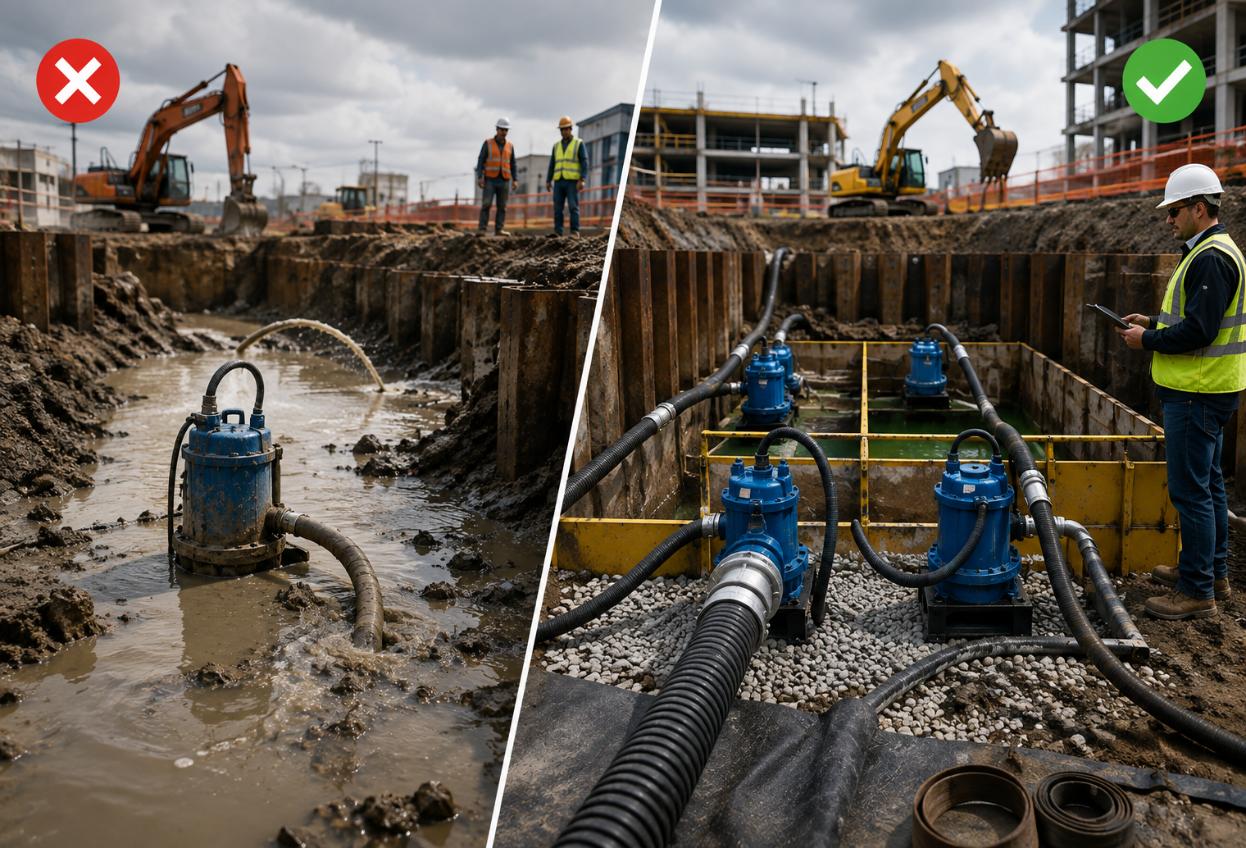
Excavation work can change quickly when groundwater, runoff, or an overnight storm starts filling a trench or work area. Around Bethel, contractors also have to account for Clermont County’s rolling terrain, drainage paths, and the East Fork watershed when deciding how to control and discharge water from a site.
Dewatering failures usually happen because the system was undersized, installed too late, allowed to clog, or operated without enough attention to where the pumped water will go. A successful dewatering plan starts before excavation reaches wet soil. Contractors should evaluate anticipated water volume, soil conditions, pump capacity, sediment control, backup equipment, and discharge location so water removal supports the project instead of creating a second problem.
What local contractors should know
-
Dewatering equipment should be sized for expected inflow plus changing conditions, not just the amount of water visible when work begins.
-
Clermont County construction planning places significant emphasis on soils, drainage areas, stormwater management, and sediment control.
-
Projects near low areas, drainage channels, or the East Fork of the Little Miami River may require extra attention to runoff and discharge conditions.
-
Pumps, hoses, filters, and discharge points should be checked throughout the workday because one blockage or failed connection can quickly reduce system performance.
-
Contractors should have a plan for rainfall and changing groundwater conditions before excavation progresses.
Why Dewatering Failures Matter on Local Jobsites
Dewatering failures matter locally because uncontrolled water can interrupt excavation, destabilize working areas, carry sediment off-site, and delay underground construction. In Bethel and surrounding Clermont County communities, rolling ground and established drainage patterns can move stormwater toward excavations faster than crews expect.
The East Fork of the Little Miami River watershed covers a substantial portion of Clermont County, and local planning documents emphasize drainage, flood zones, soils, and erosion control. Those factors make water management more than a pump-selection decision.
A trench that is manageable during dry weather can behave very differently after repeated rain. A low section of a site can also collect runoff from surrounding grades even when groundwater itself is not especially high.
For contractors seeking dewatering support in the area, Gullett Sanitation Services Inc is the local business behind this guide. We encourage crews to treat dewatering as part of overall site planning rather than something addressed only after standing water appears.
Local Data and Site Planning Considerations
Clermont County planning requirements show that soils, drainage areas, tributary drainage features, flood zones, grading limits, and stormwater systems can all be relevant to site development. That means contractors should understand how excavation and pumping fit into the larger drainage plan before moving significant amounts of water.
County Water Management and Sediment Control materials also address construction-site runoff, sediment controls, inspections, and corrective action when best management practices do not perform as intended.
For projects around Tate Township, Williamsburg, Felicity, Batavia, and nearby rural areas, conditions can vary considerably from one site to another. A dewatering setup that works well on one excavation should not automatically be duplicated on the next without evaluating the new site.
How Poor Dewatering Affects a Construction Project
Poor dewatering can affect excavation stability, productivity, equipment access, scheduling, and the condition of surrounding property. Water collecting around the bottom of a trench may soften working surfaces, make grade control more difficult, and increase the amount of sediment crews have to manage.
Persistent water can also interfere with pipe bedding, utility work, foundations, or other activities that depend on a reasonably dry and stable excavation.
On projects in Bethel, delays can compound quickly if crews have equipment, subcontractors, or inspections scheduled around excavation progress. Getting water management under control early helps preserve the sequence of work.
Warning Signs That a Dewatering System Is Failing
A failing dewatering system usually gives contractors visible warning signs before the site becomes completely unmanageable. Crews should watch for:
-
Water levels continuing to rise while the pump is operating.
-
Pumps cycling constantly without lowering the excavation water level.
-
Heavy sediment or muddy water entering suction points.
-
Filters, strainers, or intake screens repeatedly clogging.
-
Hoses flattening, leaking, separating, or restricting flow.
-
Water returning toward the excavation after discharge.
-
Softening soil, sloughing trench walls, or expanding wet areas around the work zone.
-
A system that performs adequately in dry weather but falls behind after rainfall.
Any one of these conditions deserves attention before excavation continues deeper.
When Contractors Should Bring in Professional Dewatering Support
Contractors should consider professional dewatering support when water volume exceeds ordinary jobsite pumping, conditions keep changing, sediment becomes difficult to control, or water removal is affecting the excavation schedule. The need becomes more urgent when crews cannot maintain a safe, workable excavation with the equipment already on site.
Minor rainwater accumulation may sometimes be handled with routine jobsite pumping when conditions and project requirements allow. Persistent groundwater, substantial inflow, deep excavation, unstable soils, or uncertain discharge conditions deserve a more deliberate approach.
Around Bethel, contractors should also consider how pumped water will move across or away from the property and whether local stormwater or sediment-control requirements apply.
Common Causes of Dewatering Failure
The most common causes of dewatering failure are incorrect sizing, poor intake placement, sediment problems, inadequate monitoring, and failure to prepare for changing site conditions.
1. Undersized pumping capacity
A pump selected only for the water visible at startup may fall behind when groundwater inflow increases or rain enters the excavation.
Better approach: Evaluate expected peak conditions and determine whether additional or backup pumping capacity is appropriate.
2. Poor intake placement
A pump sitting directly in loose mud can pull large amounts of sediment into the system.
Better approach: Use an appropriate sump, intake arrangement, or filtering method that allows water to collect while limiting unnecessary sediment pickup.
3. Clogged hoses or strainers
Sediment, debris, and damaged hoses can reduce flow even when the pump itself is operating.
Better approach: Inspect the entire water path, not just the pump.
4. Poor discharge planning
Moving water out of the excavation does not solve the problem if it runs downhill and returns.
Better approach: Choose a discharge point that prevents recirculation and accounts for erosion, sediment, neighboring property, and applicable site requirements.
5. No rainfall contingency
A system designed around normal groundwater may be overwhelmed by storm runoff.
Better approach: Monitor the forecast and maintain a practical response plan for wet weather.
How Contractors Can Prevent Dewatering Problems
Contractors can prevent many dewatering problems by planning the system before excavation reaches wet conditions and inspecting it throughout the project. Preparation is especially useful during wetter periods when runoff from surrounding grades can suddenly increase the amount of water entering a work area.
Before digging, identify low points, drainage paths, likely discharge locations, and areas where soil could erode. Confirm that pumps, hoses, fittings, strainers, and backup equipment are ready before they become critical.
During operation, crews should regularly check water levels, pump output, sediment buildup, hose condition, and the discharge area. After substantial rainfall, recheck the entire setup rather than assuming yesterday’s configuration is still adequate.
DIY monitoring should stop when crews cannot maintain the excavation, equipment is repeatedly clogging or failing, soil conditions are deteriorating, or there is uncertainty about how water should be handled.
What Contractors Can Expect From a Well-Planned Dewatering Setup
A well-planned dewatering setup should help maintain a more workable excavation, reduce interruptions caused by standing water, and give crews greater control over changing site conditions. Results still depend on groundwater, soil, excavation depth, weather, equipment selection, and discharge limitations.
The goal is not simply to run a pump continuously. Effective dewatering removes water at a rate and from a location that supports the construction process while managing sediment and discharge responsibly.
That distinction is especially important on Clermont County jobs where drainage paths and surrounding grades may affect how quickly water returns to the work area.
Common Dewatering Mistakes and Better Approaches
Mistake: Waiting for the excavation to flood.
Consequence: Crews lose productive time while trying to assemble a system under pressure.
Better approach: Plan equipment and discharge before water becomes disruptive.
Mistake: Assuming one pump fits every site.
Consequence: Capacity may be inadequate for changing inflow.
Better approach: Match the setup to site-specific conditions.
Mistake: Ignoring sediment.
Consequence: Intakes clog and discharge becomes harder to manage.
Better approach: Include sediment control in the original setup.
Mistake: Discharging too close to the excavation.
Consequence: Pumped water can return to the same low area.
Better approach: Evaluate grade and drainage before choosing the outlet.
Mistake: Operating without backup equipment.
Consequence: One failure can stop excavation work.
Better approach: Decide in advance what will happen if the primary system goes down.
A Common Bethel-Area Dewatering Scenario
A common local scenario is a contractor opening an excavation during relatively dry conditions and using a basic pump to handle minor seepage. Rain later moves across the surrounding grade, inflow increases, and sediment begins collecting around the intake.
The pump continues running but cannot keep the work area dry. Moving the pump alone may not solve the problem because the actual failure involves capacity, runoff entering the excavation, sediment buildup, or an ineffective discharge location.
This is why dewatering around Bethel should be treated as a system rather than a single piece of equipment.
Related Dewatering Solutions
The right dewatering solution depends on excavation depth, soil, water volume, project duration, access, and the amount of sediment involved. Contractors may need anything from improved pumping and intake management to a more structured temporary dewatering arrangement.
If water is interfering with your project, contact us to discuss the site conditions and determine the next practical step.
Comparing Temporary Jobsite Pumping and Planned Dewatering
Temporary jobsite pumping works best for small, predictable amounts of water that can be removed safely without creating additional site problems. Planned dewatering is more appropriate when water is persistent, excavation conditions are sensitive, or maintaining a dry work area is essential to continued construction.
The cheapest short-term setup is not necessarily the lowest-cost option if crews repeatedly stop work, replace clogged equipment, or rework damaged areas.
For contractors, the better comparison is usually total project disruption versus the level of water control required to keep work moving.
Service Areas
We serve contractors working in and around Bethel and nearby communities in the Clermont County area. Depending on project location, that may include surrounding areas such as Tate Township, Williamsburg, Felicity, Batavia, and communities toward the Clermont and Brown County line.
The Cost of Ignoring a Dewatering Problem
Ignoring a dewatering problem can lead to lost production time, damaged working surfaces, recurring pumping problems, sediment movement, and additional site cleanup. The longer crews work around uncontrolled water, the more likely the issue is to affect other parts of the construction schedule.
A system that is already struggling rarely becomes more reliable simply because excavation continues.
If water is beginning to interfere with access or production, addressing the cause early can help reduce avoidable downtime.
Frequently Asked Questions
What causes most dewatering failures in Bethel?
Most dewatering failures come from inadequate pump capacity, clogged intakes, poor discharge placement, sediment buildup, or unexpected increases in water entering the excavation. Local grades and rainfall can also send runoff toward low work areas, so contractors should evaluate both groundwater and surface drainage when planning a system.
Should contractors wait until groundwater appears before arranging dewatering?
No. Contractors should plan for dewatering before groundwater or stormwater begins interfering with excavation. Early preparation makes it easier to identify equipment, discharge locations, sediment controls, and backup options. Waiting until the excavation is already flooded can turn a manageable site condition into a schedule problem.
Why is sediment control important on Clermont County construction sites?
Sediment control is important because pumped or storm-driven water can carry soil away from disturbed areas and into drainage systems or surrounding property. Clermont County Water Management and Sediment Control materials specifically address erosion, sediment, inspections, and corrective measures, making sediment management an important part of local site planning.
Can a larger pump fix every dewatering problem?
No. A larger pump may increase capacity, but it will not correct poor intake placement, clogged hoses, excessive sediment, recirculating discharge water, or uncontrolled runoff entering the excavation. Contractors should diagnose the entire system before assuming pump size is the only problem.
How does rainfall affect dewatering around Bethel?
Rainfall can increase the amount of water reaching an excavation through direct precipitation and runoff from surrounding grades. A system handling normal seepage may fall behind during wet weather. Contractors should inspect drainage paths and reassess pumping capacity whenever significant rain changes site conditions.
Where should dewatering water be discharged?
Dewatering water should be discharged to an appropriate location that does not simply send the water back toward the excavation or create erosion, sediment, or neighboring-property problems. The correct location depends on the site and applicable project requirements, so discharge planning should occur before pumping begins.
What should crews inspect while a dewatering system is running?
Crews should inspect water levels, pump performance, suction points, filters or strainers, hoses, fittings, sediment accumulation, and the discharge location. Inspections are particularly useful after rain or changes in excavation depth because the same system can perform differently as site conditions change.
When should a contractor call for professional dewatering help in Clermont County?
A contractor should seek professional help when routine pumping no longer keeps the excavation workable, inflow continues increasing, sediment repeatedly clogs equipment, or site conditions make discharge difficult to manage. Professional support may also be appropriate when water problems begin affecting excavation stability, sequencing, or productivity.
Keep Water From Controlling Your Construction Schedule
Reliable dewatering starts with understanding the site, preparing for changing conditions, and correcting problems before they shut down excavation. We can help contractors in the Bethel area evaluate dewatering needs and keep water management focused on supporting the work.