Industrial facilities across Ohio face an ongoing challenge: managing wastewater sludge efficiently while controlling disposal costs and maintaining reliable operations. From manufacturing plants in Cleveland and Akron to industrial operations in Columbus and Toledo, sludge handling can affect production schedules, transportation expenses, and wastewater treatment performance.
A sludge dewatering centrifuge helps facilities reduce the amount of water contained in sludge, making the remaining solids easier to handle, transport, and dispose of.
Quick Answer: A sludge dewatering centrifuge works by spinning wastewater sludge at high speeds to separate solids from liquids using centrifugal force. The heavier solids collect against the rotating bowl and are transported toward a discharge outlet, while separated liquid exits through another outlet. For Ohio industrial facilities, this process can reduce sludge volume, improve handling efficiency, and potentially lower hauling and disposal costs.
What Ohio Industrial Facilities Should Know
-
Sludge dewatering centrifuges use centrifugal force to separate suspended solids from wastewater sludge.
-
Manufacturing and wastewater treatment operations in Cleveland, Akron, and Canton may use centrifuge technology to manage industrial sludge.
-
Reducing sludge moisture can decrease the total weight of material requiring transportation and disposal.
-
Ohio facilities must evaluate sludge characteristics and applicable Ohio Environmental Protection Agency requirements before selecting treatment and disposal methods.
-
Centrifuge performance depends on feed consistency, polymer conditioning, equipment settings, and ongoing maintenance.
For facilities operating throughout Northeast Ohio and other industrial regions of the state, understanding centrifuge operation can help managers make informed decisions about wastewater treatment and sludge management.
Gullett Sanitation Services Inc. recognizes the importance of practical sludge management for industrial operations. We encourage facilities to evaluate their wastewater characteristics, operational requirements, and available service options before choosing a dewatering approach.
How Does a Sludge Dewatering Centrifuge Separate Solids From Liquids?
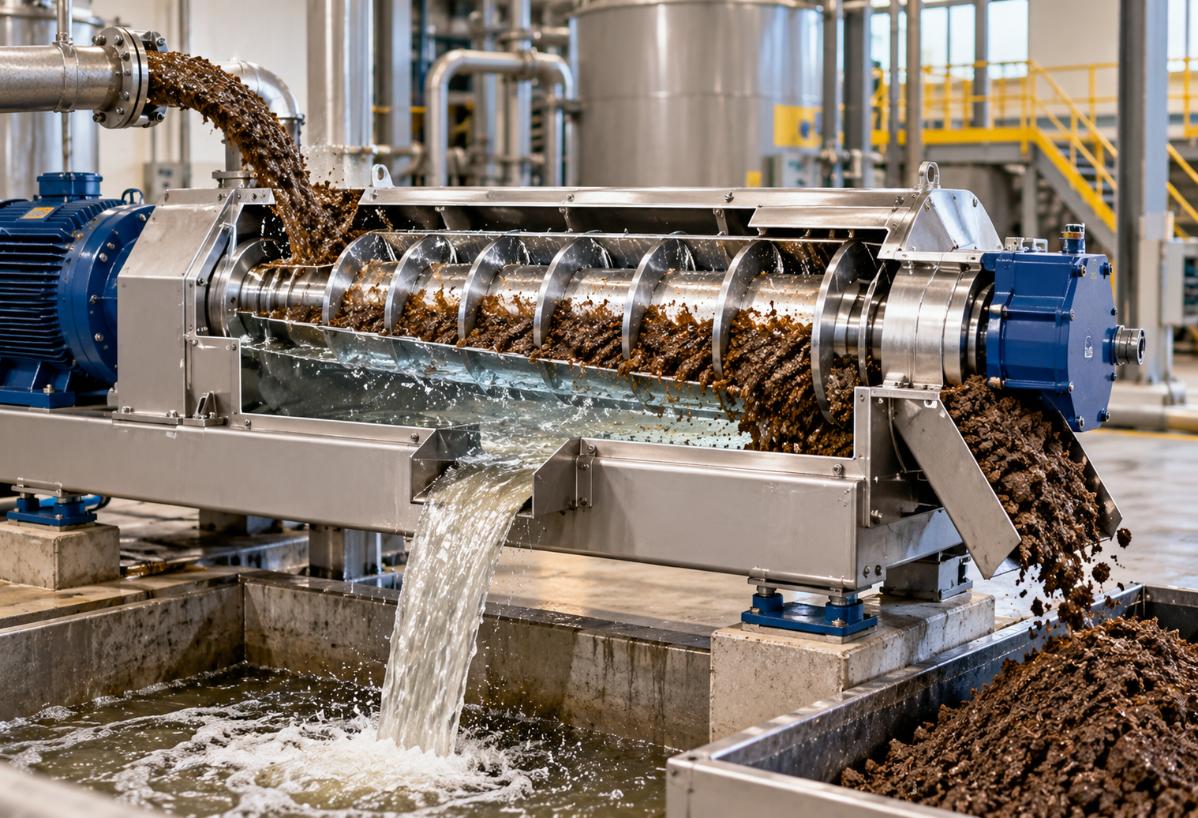
A sludge dewatering centrifuge separates solids from liquids by rotating sludge inside a high-speed cylindrical bowl. Centrifugal force pushes denser solid particles toward the bowl wall, while the liquid forms an inner layer. An internal screw conveyor continuously moves the concentrated solids toward a discharge point.
The separation process generally follows five stages:
-
Sludge enters the centrifuge. Wastewater sludge is pumped into the rotating equipment through a feed pipe.
-
Centrifugal force separates materials. Rapid rotation accelerates the settling of suspended solids.
-
Solids accumulate against the bowl. Heavier particles collect along the inside surface of the centrifuge.
-
The conveyor moves the solids. A rotating screw, operating at a slightly different speed than the bowl, transports concentrated sludge toward the solids discharge.
-
Separated materials exit independently. Dewatered solids leave through one outlet, while the separated liquid, commonly called centrate, exits through another.
The discharged solids are often called sludge cake. Their moisture content depends on the sludge composition, equipment configuration, and operating conditions.
For Ohio industrial facilities handling substantial sludge volumes, continuous centrifuge operation can offer advantages over equipment that requires frequent interruptions for solids removal.
Local Data or Field Observations: Sludge Management in Ohio
Ohio sludge management requirements depend on the industrial process, wastewater characteristics, treatment system, and intended disposal method. The Ohio Environmental Protection Agency oversees applicable wastewater discharge and waste management requirements, while federal rules may also affect certain industrial waste streams.
Facilities in the Cleveland-Akron industrial corridor, the Toledo manufacturing region, and the Columbus metropolitan area may generate different sludge types based on their production activities.
Common industrial sludge characteristics include:
-
High concentrations of suspended solids.
-
Variable moisture content.
-
Oils, grease, or other process-related substances.
-
Fine particles that resist settling.
-
Changing sludge consistency during production cycles.
These are general industrial treatment considerations, not measurements from a particular Ohio facility.
Because sludge characteristics vary, laboratory testing and equipment trials are often useful before establishing operating targets.
How Sludge Dewatering Affects Ohio Industrial Operations
Sludge dewatering affects Ohio industrial operations by reducing the water transported with waste solids and improving the consistency of sludge handling. Facilities that produce wet sludge regularly may benefit from fewer hauling loads, more manageable storage requirements, and improved scheduling of downstream waste handling.
Potential operational benefits include reduced transportation weight, better control of storage capacity, and more predictable material handling.
However, centrifuges also require electricity, maintenance, and sometimes chemical conditioning. The financial benefit depends on whether the reduction in hauling and disposal expenses outweighs those operating costs.
During Ohio winters, facilities should also consider freezing conditions around exposed piping, pumps, and sludge handling equipment. Proper equipment protection can help reduce weather-related disruptions.
Warning Signs Your Sludge Dewatering Process Needs Attention
Warning signs of sludge dewatering problems include wetter-than-normal sludge cake, inconsistent separation, and unusual equipment behavior. Recognizing these changes early can help Ohio facility operators prevent avoidable interruptions.
Watch for these seven indicators:
-
Excessively wet sludge cake: Discharged solids contain more moisture than expected.
-
Cloudy centrate: Excess suspended solids appear in the separated liquid.
-
Unusual vibration: Equipment develops shaking or vibration outside its normal operating range.
-
Reduced processing capacity: The centrifuge handles less sludge than its established operating baseline.
-
Increasing polymer consumption: Chemical usage rises without a corresponding improvement in separation.
-
Frequent shutdowns or alarms: Operating interruptions become more common.
-
Higher hauling expenses: Wet sludge increases transportation weight or disposal requirements.
These symptoms do not always indicate mechanical failure. Feed characteristics, chemical dosing, and operating settings can also affect performance.
When Should an Ohio Facility Call a Sludge Dewatering Professional?
An Ohio industrial facility should contact a qualified sludge dewatering professional when routine operating adjustments cannot restore acceptable cake dryness, centrate clarity, or processing capacity. Persistent vibration, mechanical alarms, and repeated shutdowns also warrant professional evaluation.
Operators can safely review approved operating records, inspect accessible equipment areas, and monitor sludge consistency according to facility procedures.
Internal mechanical inspection, rotating component repairs, and electrical troubleshooting should be handled by qualified personnel using appropriate shutdown and lockout procedures.
For facilities in Akron, Cleveland, and surrounding industrial communities, timely evaluation can help prevent sludge accumulation from interfering with production or wastewater treatment schedules.
Common Causes of Poor Sludge Dewatering Performance in Ohio
Poor sludge dewatering performance usually results from changes in sludge composition, incorrect chemical conditioning, unsuitable operating settings, or equipment wear. Ohio industrial facilities may experience these conditions when production processes, wastewater loads, or seasonal operating demands change.
1. Variable Sludge Composition
Manufacturing changes can alter particle size, solids concentration, and sludge chemistry. These changes affect how readily solids separate from water.
2. Improper Polymer Conditioning
Some sludge requires polymer treatment to encourage smaller particles to combine into larger flocs. Incorrect polymer selection or dosing can reduce separation efficiency.
3. Incorrect Centrifuge Settings
Bowl speed, differential conveyor speed, and feed rate influence cake dryness, solids recovery, and processing capacity.
4. Mechanical Wear
Conveyor flights, bearings, seals, and other components may deteriorate during prolonged operation, especially when sludge contains abrasive material.
5. Seasonal and Operational Changes
Cold Ohio weather can affect exposed equipment and sludge handling systems. Changes in plant production can also create fluctuations in wastewater volume and composition.
Identifying the underlying cause is more effective than repeatedly adjusting equipment without supporting operating data.
Sludge Dewatering Prevention and Maintenance
Preventive maintenance for sludge dewatering centrifuges involves monitoring operating conditions, inspecting mechanical components, and maintaining consistent feed and chemical treatment. Ohio facilities can reduce unexpected disruptions by combining manufacturer-recommended maintenance with regular process performance reviews.
Useful maintenance practices include:
-
Record sludge feed rates and solids concentrations.
-
Monitor sludge cake dryness and centrate clarity.
-
Review polymer dosage and conditioning performance.
-
Track vibration, bearing temperatures, and operating alarms.
-
Inspect pumps, piping, and accessible discharge areas.
-
Follow manufacturer lubrication and component inspection schedules.
-
Protect vulnerable equipment and piping before freezing weather.
Facilities should also review maintenance procedures before seasonal production changes or planned shutdowns.
Operators should never open or service rotating equipment until it has been properly isolated, stopped, and secured under approved safety procedures.
What Results Can Ohio Facilities Expect From Centrifuge Dewatering?
Ohio facilities can expect centrifuge dewatering to produce a more concentrated solids stream and a separated liquid stream, although the achievable cake dryness and solids recovery vary significantly by sludge type.
Some sludge streams respond well to mechanical dewatering, while others retain substantial moisture because of particle size, organic content, or chemical characteristics.
A realistic performance evaluation should consider:
-
Final sludge cake solids concentration.
-
Percentage of suspended solids captured.
-
Quality of the separated centrate.
-
Polymer and electricity consumption.
-
Maintenance requirements.
-
Hauling and disposal costs.
A centrifuge does not automatically make industrial sludge suitable for landfill disposal or other reuse. Waste characterization and applicable disposal requirements still determine how the material must be managed.
Common Sludge Dewatering Mistakes Ohio Facilities Should Avoid
Common sludge dewatering mistakes involve operating equipment without adequate testing, ignoring changes in sludge characteristics, or focusing only on cake dryness. These decisions can increase costs or reduce treatment performance.
Mistake: Selecting equipment based only on processing capacity.
Consequence: The centrifuge may handle the required volume but fail to achieve acceptable solids recovery or cake dryness.
Better approach: Evaluate capacity alongside sludge composition, discharge requirements, and downstream handling costs.
Mistake: Increasing polymer dosage without testing.
Consequence: Excess chemical consumption may increase costs without improving separation.
Better approach: Conduct controlled dosing evaluations and monitor both cake and centrate quality.
Mistake: Ignoring equipment vibration.
Consequence: Continued operation may worsen mechanical wear or create unsafe conditions.
Better approach: Follow manufacturer alarm limits and obtain qualified inspection when needed.
Mistake: Assuming dewatering eliminates disposal obligations.
Consequence: Facilities may overlook required waste characterization, handling, or documentation.
Better approach: Confirm applicable Ohio waste management requirements before changing disposal practices.
Common Local Scenario: A Northeast Ohio Manufacturing Facility
A common sludge management scenario involves a Northeast Ohio manufacturing facility that generates wastewater treatment sludge throughout the workweek. As production increases, the volume of wet sludge requiring storage and hauling also grows.
The facility begins evaluating centrifuge dewatering to reduce the water content of its waste stream.
Before selecting equipment, its operations team reviews sludge samples, production volumes, polymer requirements, available space, and disposal arrangements.
A suitable centrifuge could produce a more concentrated sludge cake, reducing the weight of material transported. The separated centrate would return to an appropriate treatment stage or follow another approved management route.
This hypothetical scenario illustrates why equipment selection should begin with process data rather than assumptions about achievable savings.
Related Sludge Management Services for Ohio Industrial Facilities
Related sludge management services can support centrifuge operations through waste characterization, sludge removal, transportation, equipment cleaning, and appropriate disposal coordination. The right combination depends on the facility’s wastewater system and the characteristics of the sludge being generated.
Industrial operators may need assistance with:
-
Sludge collection and removal.
-
Industrial tank or containment cleaning.
-
Sludge transportation.
-
Waste handling and disposal planning.
-
Coordination during equipment maintenance or shutdowns.
Gullett Sanitation Services Inc. can be contacted to discuss facility requirements and confirm which sludge management services are available for a specific Ohio location.
Comparing Sludge Dewatering Options for Ohio Facilities
Comparing sludge dewatering options requires examining the type of sludge, available operating space, labor requirements, treatment goals, and total ownership costs. Centrifuges are one option, but belt filter presses and screw presses may also be suitable for certain Ohio industrial applications.
| Dewatering method | Main advantage | Key consideration |
|---|---|---|
| Centrifuge | Continuous operation with a relatively compact footprint | Energy consumption, wear, and operating adjustments |
| Belt filter press | Continuous processing with accessible filtration components | Washwater use and belt maintenance |
| Screw press | Often operates at relatively low rotational speeds | Suitability varies by sludge characteristics |
| Off-site sludge management | May reduce the need for on-site dewatering equipment | Transportation, treatment, and disposal costs |
A facility with limited floor space may find a centrifuge attractive, while another operation may prioritize lower energy consumption or simpler maintenance.
Pilot testing or vendor-supported sludge testing can help determine which technology offers the most practical results.
Service Areas: Industrial Sludge Management Across Ohio
Industrial facilities throughout Cleveland, Akron, Canton, Toledo, Columbus, and surrounding Ohio communities encounter sludge management challenges associated with wastewater treatment and manufacturing processes.
Businesses in Cuyahoga County, Summit County, Stark County, and other industrial regions should evaluate available service providers based on waste characteristics, regulatory requirements, and confirmed service coverage.
The Cost of Ignoring Sludge Dewatering Problems
Ignoring sludge dewatering problems can increase hauling expenses, consume valuable storage capacity, and create wastewater treatment disruptions. Ohio facilities with limited sludge storage or demanding production schedules may experience operational pressure when wet sludge accumulates faster than it can be removed.
Poor separation can also return excessive suspended solids to the wastewater treatment process, increasing the load on downstream treatment equipment.
Addressing performance problems early allows facility managers to compare repair, maintenance, and alternative waste handling options before conditions become more difficult to manage.
Frequently Asked Questions About Sludge Dewatering Centrifuges in Ohio
How does a sludge dewatering centrifuge work?
A sludge dewatering centrifuge spins wastewater sludge at high speed to separate solids from liquid. Heavier particles move toward the rotating bowl wall, where a screw conveyor transports them toward discharge. The separated liquid exits independently, leaving a more concentrated sludge cake for handling or disposal.
Are sludge dewatering centrifuges suitable for Ohio manufacturing facilities?
Yes, sludge dewatering centrifuges can be suitable for Ohio manufacturing facilities that generate wastewater treatment sludge with characteristics compatible with centrifugal separation. Suitability depends on solids concentration, particle properties, processing volume, and operating requirements. Testing representative sludge samples is the most reliable way to assess potential performance.
Can a centrifuge reduce sludge disposal costs in Cleveland?
A centrifuge may reduce sludge disposal costs for Cleveland industrial facilities by removing water before transportation. Lower sludge weight can reduce hauling requirements, depending on disposal arrangements. However, facilities should compare potential savings against equipment investment, electricity, polymer consumption, maintenance, and labor before estimating financial benefits.
What happens to the liquid removed from sludge?
The liquid removed from sludge, called centrate, usually requires additional management or treatment. Many industrial facilities return it to an appropriate wastewater treatment stage. In Ohio, its final handling depends on wastewater characteristics, the facility’s treatment system, and applicable discharge permit requirements.
How often should industrial centrifuges receive maintenance?
Industrial centrifuges should receive maintenance according to manufacturer recommendations, operating hours, sludge characteristics, and observed equipment condition. Facilities in Akron and other Ohio industrial communities should establish inspection schedules covering vibration, lubrication, bearings, conveyor wear, and operating performance. Abrasive sludge or demanding operating conditions may require more frequent attention.
Does Ohio regulate industrial sludge disposal?
Yes, Ohio regulates industrial waste management through applicable state requirements, with federal regulations also applying to certain waste streams. The Ohio Environmental Protection Agency administers relevant programs. Sludge classification, waste characteristics, and the intended disposal method determine specific obligations. Dewatering alone does not remove hazardous waste or other regulatory requirements.
Can cold Ohio winters affect sludge dewatering equipment?
Yes, cold Ohio winters can affect sludge dewatering systems when piping, pumps, discharge equipment, or associated components are exposed to freezing temperatures. Facilities should evaluate insulation, heating, drainage, and winter shutdown procedures. Temperature-related changes in sludge characteristics may also influence treatment performance in some operations.
What is the difference between sludge thickening and sludge dewatering?
Sludge thickening increases solids concentration primarily to reduce the volume entering later treatment stages. Sludge dewatering removes additional liquid to produce a more concentrated material, often called sludge cake. Ohio industrial facilities may use both processes, depending on treatment system design and downstream waste handling requirements.
Should a Toledo industrial facility rent, purchase, or outsource sludge dewatering?
A Toledo industrial facility should compare rental, purchase, and outsourced dewatering based on sludge volume, frequency, available staff, equipment space, and disposal costs. Purchasing may suit consistent long-term demand, while temporary equipment or outside services may fit periodic projects. Waste testing and cost comparisons should guide the decision.
When should an Ohio industrial facility request professional sludge management assistance?
An Ohio industrial facility should request professional assistance when sludge accumulation, inconsistent dewatering performance, storage limitations, or transportation requirements begin affecting operations. Qualified support is particularly useful when waste characteristics change or disposal requirements are unclear. Facilities should confirm provider capabilities and regulatory responsibilities before scheduling work.
Supporting Reliable Sludge Management for Ohio Industry
Understanding how a sludge dewatering centrifuge works helps Ohio industrial facilities make better decisions about wastewater treatment, equipment maintenance, and sludge disposal.
By monitoring separation performance, planning maintenance, and evaluating waste handling requirements, industrial operators can improve efficiency while reducing avoidable disruptions.
At Gullett Sanitation Services Inc., we understand that every industrial facility has different sludge management considerations. Discussing those needs early can help identify practical next steps.
Keep Your Ohio Industrial Sludge Management Process Moving
Effective sludge management starts with understanding your waste stream, operational demands, and available treatment options.